
Puppeteers are born, not made...
People's Artist of the Russian Federation, Zinovi Gerdt, is now absolutely sure of that... However, he came to this opinion not at once...
The Soviet Land and the Puppet Theatre
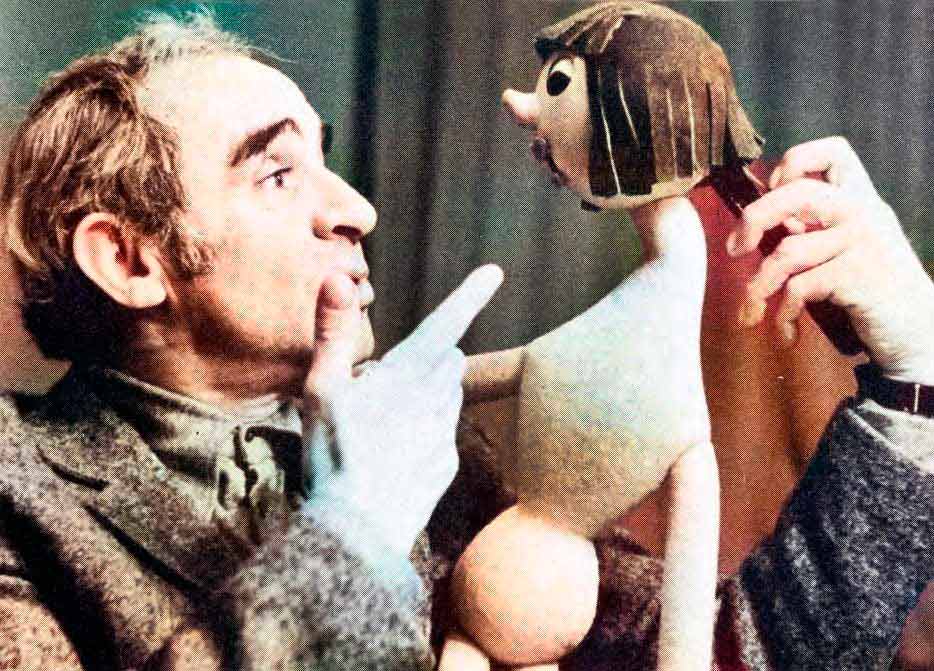
Zinovi Gerdt making friends with a future stage lead. The actor believes that a «feeling» for puppets is the main thing in his profession.
Photograph by Alexander Lyskin
...The eleven operations he had undergone helped only partially. His leg had been amputated, but he could not bend it at the knee. Yet he was a bom actor, and dreamed of the stage since childhood, before the war had finished a drama studio, and even as he lay on his hospital bed he could not bear to part with his cherished ambition... Zinovi Gerdt, former commander of a Guards Sapper Company, does not like recalling the bitter battle near Belgorod in August 1943, in which he received that terrible wound.
Later, during the long months of being shifted from hospital to hospital, he had plenty of time to think things over, to plan how to go on living. Gerdt decided to return to acting, but to act behind a screen, to be an actor invisible to his audience.
The year the war ended, he was discharged from hospital. Trying not to limp too much, he appeared for an audition before Sergei Obraztsov, director of the Puppet Theatre in Moscow.
I asked Zinovi Gerdt to tell me briefly what, to his mind, a dramatic actor and a puppeteer had in common, and what differences existed in their work.
"A puppet theatre actor must first of all be a good actor! As for the specifics of his work, he must have a special quality: a feeling for puppets. Some fine actors come to us from drama theatres, trying to get the hang of this genre. But frankly speaking, they seldom succeed. For some the most difficult thing is to deny themselves the pleasure of acting in full view of the audience."
Zinovi Gerdt is quite sure that vanity and the puppet theatre are not compatible. The actor is hidden behind a screen, he wears working clothes, his colleagues work closely by his side. The team spirit is inherent in the puppeteer, it arises from the nature of the profession.
"Let’s say I am the master-of-ceremonies in An Unusual Concert," he said to me. "My puppet is a big object weighing some six kilograms. It has a large head and body and arms. I hold its framework on a special support. I manipulate its mouth, I make it speak, I make it turn. I simply haven’t enough hands to make my puppet gesticulate. Nina Tabakova, an actress, controls the puppet’s arms."
During performances Gerdt sometimes deviates from his set text. Someone in the audience might laugh a little too loudly — his puppet will then look that way, or even address himself to the lady in the sixth row... And though Nina Tabakova has no foreknowledge of this, she instinctively senses everything. "It is as though we have a single blood circulation system," Zinovi Gerdt said.
In the course of the interview Gerdt referred to the mutual relations between the actors several times. He spoke with great warmth about his comrades — of Speransky, who is modest to a fault and who is the author of over a dozen plays; of Samodur's rare gift as a comedian, and of Sergei Obraztsov, their director, as enthusiastic about puppets as a child.
A sense of responsibility for a production or performance is ingrained in each one of the actors of the Puppet Theatre, almost to the point of a cult. Their attitude to work stems from their love of what they are doing, from their striving to plant the seeds of goodness and justice. The desire to instill these qualities in people is felt equally whether the plays are for children or adults. It should be remembered that to mount a performance for children is not the slightest bit easier than for adults. When asked to compose a "little poem" Samuel Marshak once wisely remarked: "They ask me to write a little poem as if it is easier to make a little watch rather than a big clock!"
Sergei Obraztsov's puppeteers are well known outside the Soviet Union. They have visited France, Britain, the USA, Poland, Federal Republic of Germany and many other countries. They appeared at the Munich Theatre in Leopoldstrasse as part of the International Arts Festival while the Olympic Games were in progress, and the local press referred to their performances as to the "absolute high point" of the festival. The amazing rapport invariably created between the audience and the Obraztsov puppets was established in Munich as swiftly as in Moscow.
Gerdt was torn by contradictory feelings when the curtain was raised: his memories of the war, his wound which troubled him so much he had been forced to take to his crutches again, and.the enthusiastic response to each of his witty repartees from the hall filled with Germans. The success which invariably accompanies Obraztsov's puppet shows here was beyond all comparison.
It should be noted that performances of An Unusual Concert in foreign countries are always conducted in the language of the country. Zinovi Gerdt normally arrives a week ahead of the rest of the troupe and writes the remarks of his m.c. on the spot, trying to make them topical and biting.
The actor considers his life's work to be in the theatre, but he has also appeared in nearly 30 films in which he has painted an impressive gallery of characters whom we love and remember. He has also dubbed many foreign films in Russian.
The more famous an actor becomes the more rarely he risks his name and career. One often hears: "No, I'm not filming just now. I'm waiting for an interesting role." Gerdt is not afraid to risk his name. We often see him in a small part which becomes memorable and significant by virtue of his sensitive interpretation. He also somehow finds time to write — he has written a number of scenarios for documentary films. But whatever interests may occupy Zinovi Gerdt at times, he invariably returns to his theatre, to his beloved puppets.
by Yuri Zarubin
from the nemsnaper Trud

Комментариев нет.